


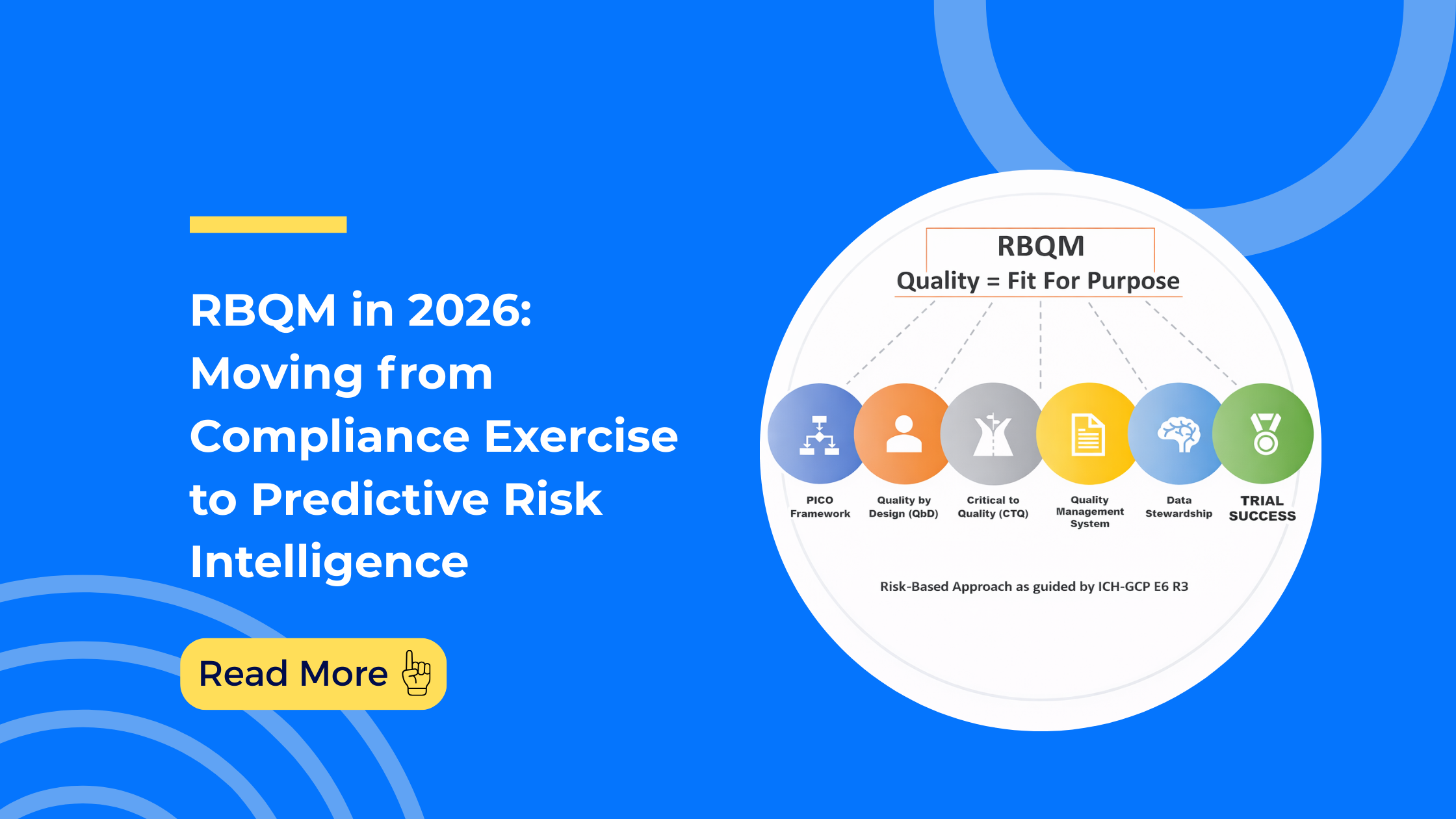
RBQM in 2026: From Compliance Exercise to Predictive Risk Intelligence in Clinical Trials
The clinical research industry is entering a new era of intelligent quality management. In 2026, Risk-Based Quality Management (RBQM) is no longer viewed as a regulatory checkbox or documentation exercise. It has evolved into a predictive risk intelligence framework powered by artificial intelligence (AI), centralized monitoring, and advanced analytics.
For every modern clinical research organization, this shift represents more than operational change—it defines competitive advantage.
What Is Risk-Based Quality Management (RBQM IN 2026)?
Risk-Based Quality Management (RBQM) is a systematic, proactive approach to identifying, assessing, and mitigating risks in clinical trials. In RBQM in 2026, this approach has become more data-driven and predictive, aligning with modern clinical trial complexities. Instead of relying solely on traditional on-site monitoring and 100% Source Data Verification (SDV), RBQM focuses on critical data and processes that directly impact patient safety and data integrity.
Regulatory authorities such as the International Council for Harmonisation of Technical Requirements for Pharmaceuticals for Human Use introduced structured risk-based frameworks through ICH E6(R2) and the evolving E6(R3), which continue to shape how RBQM in 2026 is implemented globally. Global regulators including the U.S. Food and Drug Administration and the European Medicines Agency further encouraged centralized monitoring and data-driven oversight models, strengthening the foundation of RBQM in 2026 across clinical research.
The Evolution of RBQM: From Reactive Monitoring to Predictive Intelligence
Traditionally, clinical trials depended heavily on on-site monitoring visits. While effective in identifying discrepancies, this model was:
Resource-intensive
Time-consuming
Often reactive rather than preventive
Early RBQM implementations were compliance-focused. Many sponsors and CROs created risk assessment documents, Key Risk Indicators (KRIs), and monitoring plans simply to satisfy regulatory expectations.
In 2026, that approach is no longer sufficient.
Modern RBQM models leverage real-time analytics and machine learning to detect patterns before risks escalate. Instead of identifying problems after they affect the study, predictive RBQM enables early intervention.
The Data Explosion Transforming Clinical Trials
Today’s clinical trials generate exponentially more data than ever before due to:
Decentralized clinical trials (DCTs)
Wearable devices
ePRO platforms
Clinical Trial Management Systems (CTMS)
Safety databases
For a forward-thinking clinical research organization, the challenge is no longer data availability—it is data interpretation.
Manual review processes cannot scale with modern data volumes. Risk signals are often hidden across multiple disconnected systems. Without advanced analytics, early warning indicators can easily be missed.
This is where predictive RBQM becomes essential.
AI and Predictive Analytics: The New Core of RBQM IN 2026
Artificial intelligence is redefining how risks are identified, assessed, and managed in clinical trials.
Instead of relying solely on static KRIs, advanced RBQM platforms use machine learning algorithms to analyze:
Unusual data entry patterns at investigator sites
Protocol deviation trends
Enrollment anomalies across regions
Safety reporting inconsistencies
Query resolution delays
AI-driven systems continuously learn from historical and ongoing trial data. This enables CROs to move beyond risk detection toward risk prediction.
The result?
Fewer protocol deviations
Faster data cleaning cycles
Improved study timelines
Stronger data integrity
Predictive RBQM transforms quality oversight from reactive correction to proactive prevention.
Centralized Monitoring as a Strategic Quality Function
Centralized monitoring has evolved into a strategic layer of trial oversight. In 2026, it complements targeted on-site monitoring rather than replacing it entirely.
Modern centralized monitoring models rely on:
Real-time dashboards
Automated trend analysis
Cross-functional risk review meetings
Integrated risk scoring models
Instead of reviewing isolated data points, centralized teams evaluate patterns and correlations across sites and subjects.
This allows:
Focused oversight on high-risk sites
Optimized resource allocation
Reduced unnecessary monitoring costs
Maintained regulatory compliance
For clinical research organizations in India and globally, centralized monitoring capabilities are becoming a major differentiator.
The Role of Data Visualization in Risk Intelligence
Complex data requires intelligent visualization.
Interactive dashboards now allow clinical operations, data management, and quality teams to:
Monitor site performance heat maps
Track protocol deviation trends
Review KRI threshold alerts
Analyze enrollment projections
Evaluate data quality scoring models
Effective visualization simplifies analytics and supports faster cross-functional decision-making.
Organizations investing in advanced visualization tools are strengthening their RBQM maturity and sponsor confidence.
Moving Beyond Compliance: Building a Proactive Quality Culture
Technology alone does not define successful RBQM implementation.
A proactive quality culture begins during protocol design and continues throughout study execution. Leading clinical research organizations embed risk management into every phase of the trial lifecycle.
Key elements of a predictive RBQM culture include:
Cross-functional risk workshops during study startup
Continuous monitoring of KRIs and Quality Tolerance Limits (QTLs)
Integration between clinical operations, data management, and QA teams
Automated workflows for risk escalation
Ongoing training in data-driven decision-making
When RBQM becomes operational rather than documentation-based, true predictive intelligence emerges.

Implementation Challenges for CROs
Despite its advantages, predictive RBQM implementation presents challenges:
Data integration across multiple platforms
Lack of standardized KRIs
Resistance to AI adoption
Limited internal analytics expertise
To overcome these barriers, modern clinical research organizations are investing in:
Data engineering infrastructure
AI-enabled monitoring tools
Risk analytics platforms
Centralized quality oversight teams
Organizations that successfully integrate these capabilities position themselves as strategic partners—not just operational vendors.
The Future of RBQM: Predictive Quality Ecosystems
The next phase of RBQM will move toward fully integrated predictive quality ecosystems.
Future trends may include:
AI-driven risk scoring across entire development programs
Predictive modeling for patient dropout risk
Real-time protocol optimization
Integration with decentralized trial technologies
Cross-study risk intelligence dashboards
As clinical trials become increasingly complex and data-driven, predictive intelligence will define the next generation of quality management.
Conclusion
In 2026, RBQM is no longer a regulatory obligation—it is a strategic framework that drives smarter, faster, and higher-quality clinical trials.
The integration of AI, centralized monitoring, and advanced data visualization is transforming how risks are identified and managed across study lifecycles.
For any clinical research organization aiming to deliver greater value to sponsors, the transition from compliance-based oversight to predictive risk intelligence is essential.
The future of clinical research quality is predictive, proactive, and technology-enabled—and RBQM stands at the center of this transformation.